Top 5 OPT Job Mistakes Students Make in the USA
Blog Index
- 1. Introduction to AI Careers in the USA
- 2. Why AI is a Top Career Choice in 2025
- 3. Job Opportunities for International & F1 OPT Students
- 4. STEM OPT Extension and AI Roles
- 5. Top Companies Hiring AI Talent in the USA
- 6. Skills Needed for AI Jobs
- 7. Salary Trends in AI Careers
- 8. Tips for Success in the AI Job Market
- 9. Conclusion
- 10. FAQs
INTRODUCTION
Securing OPT jobs in the USA requires a strong skillset with the primary goal of working and growing. The competition is intense, and standing at the top requires hard work with additional effort. When employers and companies seek to hire OPT candidates, they want the candidate to have prior knowledge of their business, understand their values, and possess a relevant skill set. In this article, we will explore the top 5 mistakes that students make when applying for OPT jobs in the USA and discuss the steps to avoid them.
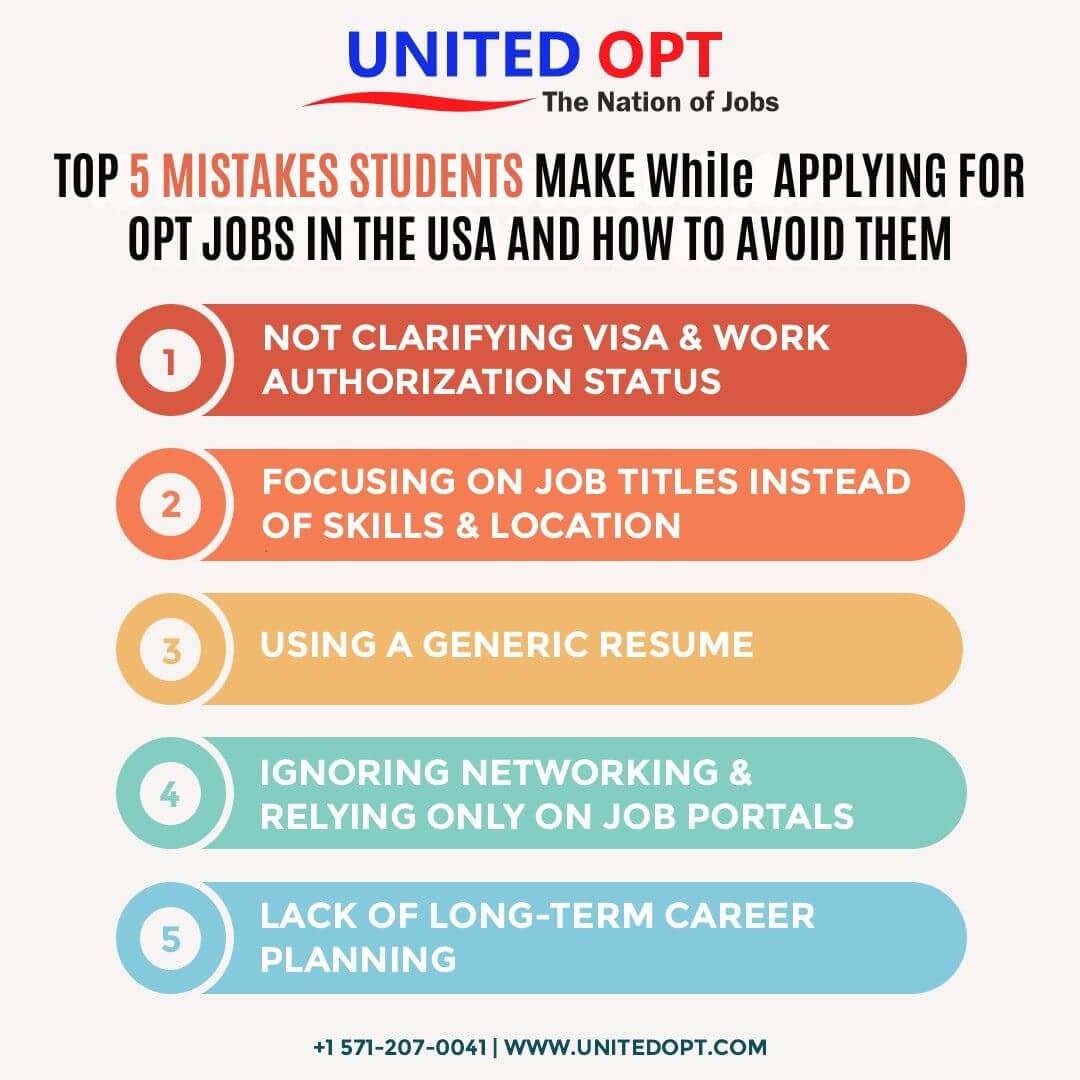
1: Applying without clarification of the visa and work authorization status to the employer
It would be difficult to hire any student without knowing their visa and work authorization status. Many OPT candidates in the USA hide their status, believing it would increase their selection chances, but the opposite is true. When employers don’t understand students’ eligibility for OPT jobs in the USA, they think it’s complicated to hire them. Companies that seek to hire OPT candidates often find the unavailability of a visa and work authorization to be a significant problem in their hiring process.
-
How to avoid it?
- The mistake can be avoided if a student clearly specifies their current status, i.e., F1 student on initial OPT, STEM OPT, or EAD status.
- Ensure the status is clearly stated on your resume, cover letter, and all other related documents. Discuss this wisely with employers.
2: Focusing on job titles rather than skills and location
If a student’s primary focus is on getting a job, but not on the job’s location & field, then there will be a problem. Students often look for OPT job opportunities or entry-level OPT jobs and apply directly, without considering other factors, which include skills required and job location, especially when applying for on-site jobs. This ultimately leads to future frustrations and inconveniences. Apply carefully after reading and analysing everything.
-
How to avoid it?
- When applying to job portals, thoroughly analyze and prioritize jobs that match your skills, degree, and long-term goals.
- Check the location. Are you ready to relocate? Ask yourself these questions.
3: Not focusing on resume and portfolio building
Applying with the same generic resume for all OPT jobs for international students isn’t a smart move; recruiters hiring OPT candidates demand a non-generic resume. Instead, focus on your skills, learn how to effectively explain them, and build a resume that outshines. The competition in the USA job market for OPT students is evolving, and to stand out, put effort into a highly valued resume, ensuring that it is ATS-friendly and keyword-optimized to minimize rejections.
-
How to avoid it?
- Tailor a resume that matches the job description.
- Write using a professional, confident, and attractive language to represent your profile.
- The goal is to create a resume that is both ATS-friendly, keyword-optimized, and professionally detailed.
4: Ignoring networking and relying on job portals only
Students often make significant mistakes in the OPT job search in the USA when they rely solely on job portals for OPT job opportunities and fail to conduct thorough research on employers. Building a strong network is a symbol of being a valuable team player. When employers see that your relationship and networking skills are strong in the industry, they often find this as an attractive trait in hiring OPT candidates. Employer value initiatives and an understanding of their business can be missed when relying completely on job portals.
-
How to avoid it?
- For an OPT job opportunity, conduct thorough research on the company for an assurance on if it hires international candidates.
- Connect with alumni via LinkedIn and build a strong relationship that showcases your skills.
5: Not considering long-term career planning
Many students focus solely on securing a job rather than planning for the long term. After graduation, the next steps may include pursuing a STEM extension or transitioning to U.S. companies. Without long-term planning, students can become stuck in short-term roles or limited by their visa constraints. Students can also proactively seek mentorship, career advising, or professional development resources to support their long-term goals. Long-term career planning involves identifying your next role and exploring opportunities to enhance your skill set.
-
How to avoid it?
- Verify if your current degree qualifies for a STEM extension, which results in a 24-month extension.
- Research and analyze how OPT jobs in the USA can lead to a better future.
CONCLUSION
There are common mistakes that international students make when searching for an OPT job opportunity; avoiding these mistakes can result in a smooth and productive career. UnitedOPT is the platform that helps students get OPT jobs in the USA. The portal is here to make your career journey smooth, with a team specializing in the OPT job marketing search. Job landing has been made easy for international students.
Visit UnitedOPT for a better understanding and OPT job opportunities.
FAQ’s
1. What is OPT, and how long can a student stay on OPT?
OPT stands for Optional Practical Training. It’s a program that allows international students on an F1 visa to work in their major area of study in the U.S. for up to 12 months.
2. How long can a student stay if he’s STEM eligible?
36 months, a student eligible for STEM can apply for a 24-month STEM OPT extension. The STEM OPT extension adds to the initial 12 months of OPT, resulting in a total of 36 months of stay.
3. How early should I apply for jobs on OPT?
- Start your job search early, i.e, 3-4 months before your OPT date. Hiring can take time.
- There is no need for OPT approval to begin applying; approval is required only before you start to work.
- Applying early will increase your job chances within the 90-day period of your OPT, which is the limit for receiving unemployment benefits.
- Equal protection and discrimination claims
4. Can any company or employer hire an OPT student?
- Yes, any employer or company can hire an opt student if they follow the standard employment regulations.
- The job should be related to the student’s field of study.
5. Where can I connect with an employer?
The following platforms can be used:
- LinkedIn: A major professional platform manages connections and applications for jobs
- Indeed: A widely used job site for regular post-job searches.
- Handshake: A platform commonly used by universities for students to connect with employers offering internships and full-time roles.
6. Can I work only in my major degree area in OPT?
Yes, you’re only allowed to work in a major area or a field related to it. This ensures that the training for work should align with your academic background. Any job or internship unrelated to your study area will not be eligible under the opt rules.
7. How can I be eligible for STEM OPT extension?
Follow the steps below for eligibility in STEM OPT Extension:
- Your degree should be present on the DHS STEM Designated Degree Program List.
- When applying for an extension, ensure that you’re on a valid post-completion option.
- Ensure your employer is enrolled in E-Verify and agrees to follow STEM OPT training and reporting requirements.
Clara Michael
Clara Michael is a Career Counsellor and Legal advisor at United OPT. she has very good working experience with OPT, CPT and H1B candidates. She has a vast knowledge of recruitment and immigration laws. Through her experience and knowledge, she is giving her best to support the international student community in the USA. Do share the article if you like it.