LEGAL CONSIDERATIONS FOR INTERNATIONAL STUDENTS ON OPT: WHAT YOU SHOULD KNOW
The Impact of H4 EAD on the Workforce: Key Trends and Opportunities
-
1. Introduction
- Overview of H4 EAD and its significance for H4 visa holders
- Why employment authorization matters for career growth
- 2. H4 EAD Eligibility Criteria
- Requirements for applying for an H4 EAD
- Key documents needed for submission
- 3. Employment Trends Before H4 EAD
- Financial dependency on H1B visa holders
- Underemployment and restricted job opportunities
- Psychological and emotional impacts on H4 visa holders
- 4. Positive Impacts of H4 EAD on the U.S. Workforce
- Economic growth through dual-income households
- Fostering innovation and entrepreneurship
- Talent utilization in industries with skill shortages
- 5. Challenges Faced by H4 EAD Holders
- Dependency on H1B visa status
- Uncertainty of immigration policy reforms
- Discrimination in the workplace
- Processing delays and limited access to benefits
- 6. Conclusion
- Summary of H4 EAD’s impact on the U.S. job market and economy
- Future considerations for H4 visa holders
- 7. Frequently Asked Questions (FAQs)
- Common questions related to H4 visa employment, study opportunities, and visa status changes
INTRODUCTION
For several international students, Optional Practical Training (OPT) serves as an essential pathway to acquiring valuable professional experience in the US. As this is a popular choice for many, understanding the legal framework is essential to prevent potential visa complications and pave the way for a successful career. This article will explore in detail the essential legal aspects of OPT, such as employment eligibility, visa limitations and common legal issues to avoid.
OPT
Is a work authorization that permits F1 international students to be employed in the USA temporarily. It gives international students a chance to gain hands on practical work experience in the field which is directly related to their field of study while applying their academic knowledge in an actual practical work environment.
OPT bridges international students’ real-world experience with the academic world hereby enhancing practical skills and experience. This article provides strategies that international students may use during their OPT journey.
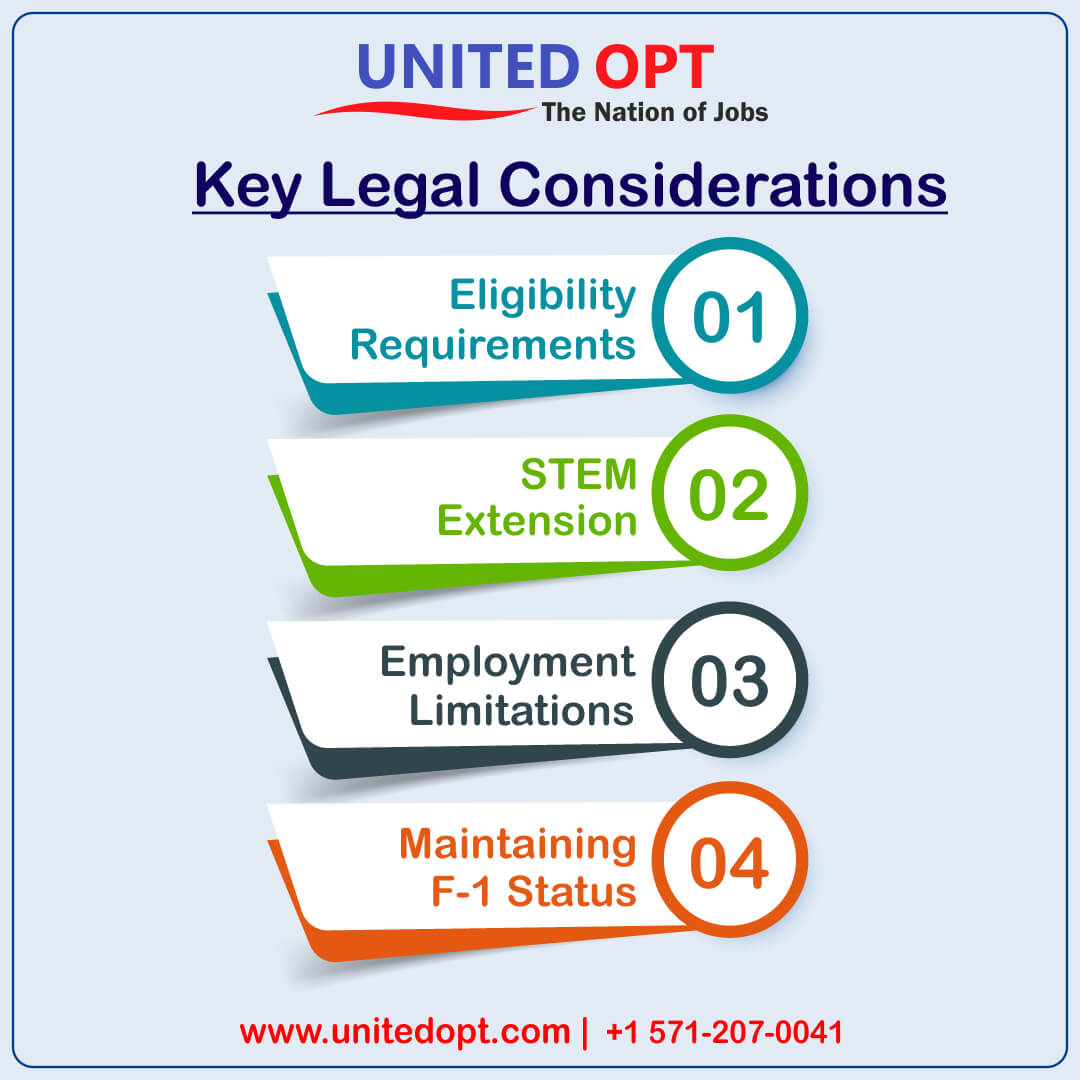
Key Legal Considerations
Here are some of the important legal you should always keep in mind:
-
Eligibility Requirements
- You are required to maintain an active F-1 status while being enrolled at an institution approved by the Student and Exchange Visitor Program (SEVP) throughout your academic program. You should complete at least one full academic year to be eligible for OPT and your job should be directly related to your field of study. You can work for multiple employers on OPT if each role is related to your degree whilst making sure the permitted working hours are not being exceeded.
-
STEM Extension
- International students who are in the STEM field are given an OPT extension of an additional 24 months. This requires eligibility while being on active Post-completion OPT, working for an E-Verify employer, and maintaining employment which is directly related to the STEM degree.
- The application process entails filling out Form I-983 (training plan) with your employer, receiving a DSO recommendation for an updated I-20, and submitting Form I-765 to USCIS before the current OPT expires. Once submitted, international students may work for up to 180 days while awaiting approval.
-
Employment Limitations
- If you are on pre-completion OPT, during school session you will work part-time (20 hours per week) whilst during break you can work full-time (40 hours per week). International students on post-completion OPT, can work full time after graduation. Students who have utilized Pre-completion OPT can still qualify for Post-completion OPT; however, the duration of Pre-completion OPT is subtracted from the overall 12-month OPT limit.
- Students participating in the STEM OPT extension are required to work for employers who are E-Verified, which confirms an employee's work authorization. When you want to extend your STEM OPT, make sure you file 90 days prior to the expiration of your current OPT. If you filed within the 90-day period, you are still eligible to continue working whilst the STEM OPT extension is under process.
- International students may face restrictions on employment with specific U.S. government agencies or organizations that require security clearance. Self-employment is allowed on regular OPT if the work directly relates to the student’s degree and meet compliance standards. However, self-employment is not permitted on STEM OPT. as international students must work for an E-Verify employer who provides supervision and completes Form I-983.
-
Maintaining F-1 Status
- Maintaining F-1 status during OPT is essential for you to legally work and reside in the US. Adhere to the employment rules and avoid exceeding the unemployment limits. Ensure all work is approved and related to your studies to avoid status issues. For any SEVIS updates, notify your DSO for any changes such as address, employment and contact details. Consistent communication and staying in touch with DSO is essential for maintaining compliance and preserving status.
- When traveling internationally, ensure you have a valid F-1 visa, an OPT EAD, a signed Form I-20, and documentation verifying your employment. The federal and state levels tax students on OPT. The tax benefits a student can claim depend on their home country; some treaties associated with tax benefits may reduce or exempt a student from paying some tax liabilities. However, this usually requires students to submit more forms. So, students must be informed of their tax obligations and maintain records to avoid penalties.
- For more detailed information on Optional Practical Training (OPT) for F-1 students, you can refer to the official USCIS page. It provides comprehensive guidelines on eligibility, application processes, and important requirements for maintaining F-1 status while on OPT. You can visit this link to access the full details: USCIS OPT Information
Common Legal Issues and How to Avoid Them
As an international student on OPT you should be aware of the legal consequences which may take place and how to avoid them. Here are the known legal challenges:
-
1. Unauthorized Employment
- This is when you work after your OPT has ended or before receiving an EAD card. You can also violate OPT by working for a role which is not related to your field of study and exceeding the permitted working hours.
- When your OPT has ended, you should immediately stop working.
- Start employment after the start date on your EAD card.
- Work for a job which is directly related to your field of study.
Ways to Avoid
-
2. Misrepresentation
- Misinterpreting information on OPT application is considered a serious violation which could lead to criminal charges, immigration fraud and removal of proceedings. This can be done when you fill in false information, forging documents and omitting critical details.
- Ensure that you read and understood everything on your OPT application form.
- Submit original and genuine documents, double check for any omissions and work with DSO for further assistance needed.
Ways to Avoid
-
3. Exceeding the Unemployment Limit
- International students on post-completion OPT are permitted up to 90 total days of unemployment, while those on combined OPT and STEM OPT are allowed up to 150 days. If you exceed these limits this may lead to termination of your F1 status.
- Start looking for employment as early as possible, just before the OPT period begins.
- You can opt for unpaid internship or volunteer opportunities to stay within the employment requirement.
Ways to Avoid
-
4. Travel-Related Issues:
- When travelling, international students should carry all the necessary documentation to avoid any consequences and ensure a smooth re-entry into the US. For a better guideline on how to smoothly travel and re-enter US, read our article, Smooth Travel and Re-Entry: Guidelines for F1 OPT Students.
- Confirm/Inform your travel plans with DSO and ensure you carry all the required documents like valid visa, EAD card, endorsed I-20, job offer letter.
- When it is during an uncertainty period like when your OPT application is pending, avoid travelling.
Ways to Avoid
CONCLUSION
It is crucial to understand and comply with the legal requirements of OPT to maintain your F-1 status and experience a successful period. You will avoid legal complications and maximize your OPT opportunity if you remain proactive, meet deadlines, and comply with regulations. For any assistance in OPT job search, visit UNITED OPT website.
FAQ’s
1. CAN I WORK FOR ANY EMPLOYER ON OPT?
No, you cannot work for any employer. You should work for an E- verified employer and, they should provide a job which is related to your field of study. The type of employment will depend on your choice which can be paid or unpaid part-time, full-time, internship and volunteer work. All your internship must be reported to the DSO (Designated School Official) and ensure to maintain all OPT compliance.
2. CAN I CHANGE MY JOB WHILE ON OPT?
Yes, you are allowed to switch OPT jobs and ascertain that job is linked to your field. You should report the changes to the DSO and ensure that your new employer is E-verified with the required documentation. Ensure that you maintain the required work hours.
3. WHAT ARE THE SPECIFIC REPORTING REQUIREMENTS FOR STEM OPT?
You should follow specific requirements which include the following:
- Report your employer’s information to the DSO eg (employer’s EIN, address, name, job title & description)
- Submit and update Form I-983 (Training Plan)
- Track and report your unemployment days to not exceed a maximum of 150 days.
- Submit a self-evaluation report to your DSO which assesses your progress and compliance.
4. WHAT ARE THE TYPICAL FAULTS TO REFRAIN FROM DURING OPT?
Avoid entering unemployment beyond limits, working without authorization, failure to update SEVIS, failure to seek STEM OPT by the deadlines, traveling without necessary documents, delaying H-1B preparation, and failing to document employment or job requirements.
5. WHAT ARE THE RULES REGARDING TRAVEL WHILE ON OPT?
Inform the DSO about your future travel plans. Make sure you carry your valid passport, visa, EAD card, endorsed I-20, job offer letter and proof of employment. If you have a pending OPT application, avoid travelling during that period. Everything should be for a smooth re-entry into the US.
6. WHAT ARE THE POSSIBLE LEGAL CONSEQUENCES OF VIOLATING OPT REGULATIONS?
Violating OPT rules can result in termination of your SEVIS record, loss of F-1 status, potential deportation, ineligibility for future U.S. visas, and difficulty adjusting to other statuses like H-1B or green card. Always follow OPT guidelines to maintain compliance.
7. WHAT HAPPENS IF I EXCEED THE UNEMPLOYMENT DAYS ALLOWED ON OPT?
If you exceed the allowed unemployment days, you may face consequences like the loss of F-1 status, which will affect your ability to stay in the US and cause ineligibility for future immigration benefits like H1B. This is considered a violation as it considered as a failure to compliance.
Clara Michael
Clara Michael is a Career Counsellor and Legal advisor at United OPT. she has very good working experience with OPT, CPT and H1B candidates. She has a vast knowledge of recruitment and immigration laws. Through her experience and knowledge, she is giving her best to support the international student community in the USA. Do share the article if you like it.