Impact of the U.S Elections on the OPT Job Market
The Impact of H4 EAD on the Workforce: Key Trends and Opportunities
-
1. Introduction
- Overview of H4 EAD and its significance for H4 visa holders
- Why employment authorization matters for career growth
- 2. H4 EAD Eligibility Criteria
- Requirements for applying for an H4 EAD
- Key documents needed for submission
- 3. Employment Trends Before H4 EAD
- Financial dependency on H1B visa holders
- Underemployment and restricted job opportunities
- Psychological and emotional impacts on H4 visa holders
- 4. Positive Impacts of H4 EAD on the U.S. Workforce
- Economic growth through dual-income households
- Fostering innovation and entrepreneurship
- Talent utilization in industries with skill shortages
- 5. Challenges Faced by H4 EAD Holders
- Dependency on H1B visa status
- Uncertainty of immigration policy reforms
- Discrimination in the workplace
- Processing delays and limited access to benefits
- 6. Conclusion
- Summary of H4 EAD’s impact on the U.S. job market and economy
- Future considerations for H4 visa holders
- 7. Frequently Asked Questions (FAQs)
- Common questions related to H4 visa employment, study opportunities, and visa status changes
INTRODUCTION
The aftermath of the recent U.S elections has stirred up significant ripples across various sectors like the OPT job market. Each election cycle brings forth changes on immigration policies, visa regulations and economic strategies which can significantly alter the opportunities available to OPT candidates. It is crucial for international students and employers to be aware of the changes which may occur. This blog delves deep into the overview of OPT, the role of OPT in the US job market, the historical impact of elections and the potential impact of the recent U.S on immigration policies.
OVERVIEW OF OPT
What is OPT?
It is a work authorization that permits F1 international students to be employed in the USA temporarily. It gives international students a chance to gain hands on practical work experience in the field which is directly related to their field of study while applying their academic knowledge in an actual practical work environment.
TYPES OF OPT
F-1 students might qualify for OPT through any one of the following three options:
PRE-COMPLETION
This is available to international students who have completed a full academic year as a full-time student at a SEVP (Student and Exchange Visitor Program) certified institution. You are allowed to work for 20 hours when it is part-time during school session and 40 hours full-time when it is during school breaks.
The period of pre-completion OPT used will be reduced from the total duration of post-completion available which is usually 12 months.
POST-COMPLETION
This is available to international students who have completed their academic program and graduated from an SEVP (Student and Exchange Visitor Program) certified institute. You are given a 12-month period of working in the U.S. Check out our blog article for a detailed guide on applying for the OPT EAD VISA.
OPT STEM EXTENSION
This is for STEM graduates who extend their regular post-completion OPT for an additional 24 months from the initial 12 months.
Read our blog article, for a more informed insight on how to apply for OPT STEM EXTENSION.
ROLE OF OPT IN THE U.S JOB MARKET
OPT has always been a bridge between the academic and real-world hence it offers benefits to international students, employers and the U.S job market. The role of OPT in the U.S job market is listed in detail as follows:
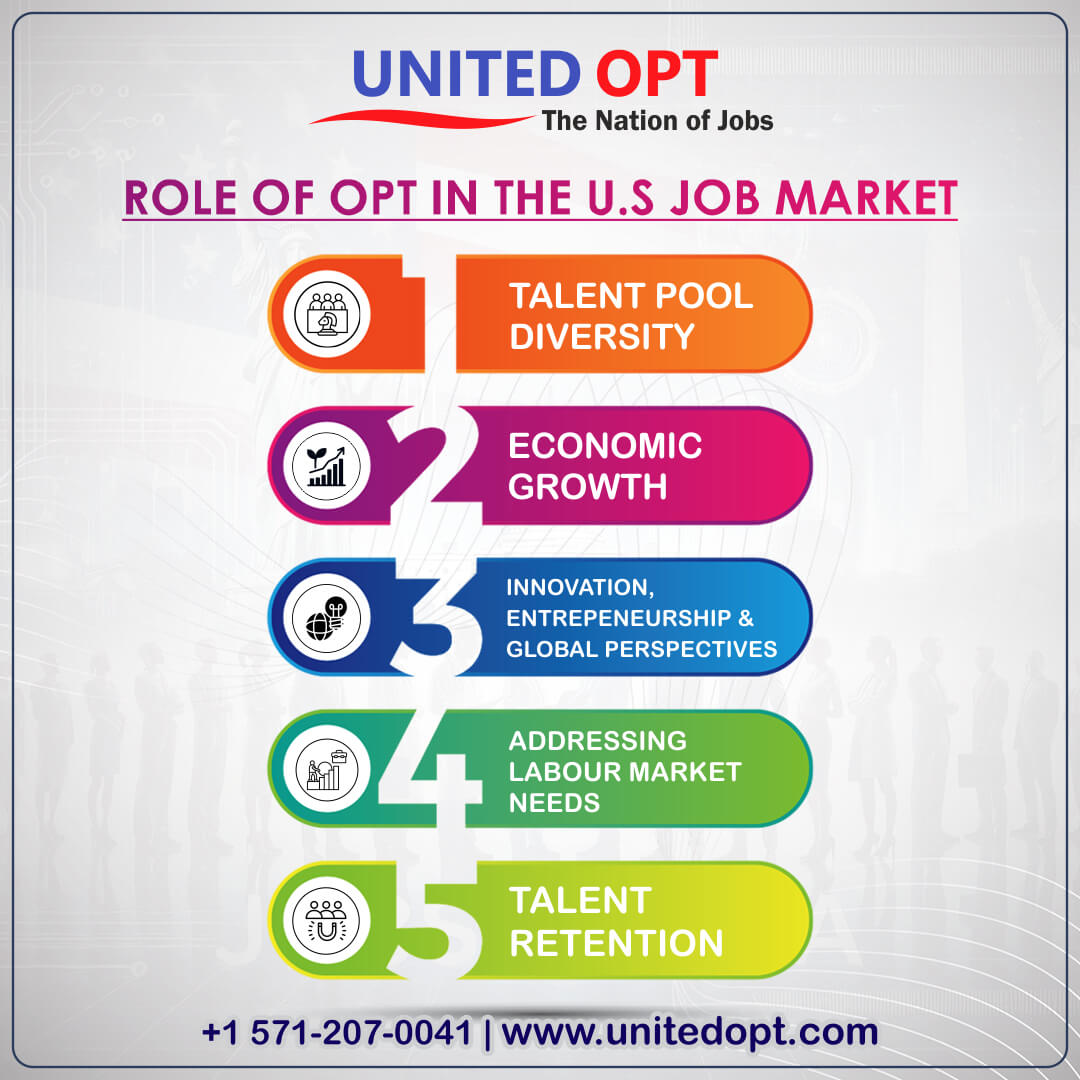
- TALENT POOL DIVERSITY
- The OPT program in the U.S. encompasses a diverse range of international students, bringing in a wide array of skills and talents. When U.S employers hire the international students on OPT, they tap in the global talent pool by obtaining access to specialized skills, cultural insights and language proficiency that may not be locally available. This fosters an inclusive and diversified workforce that tackles obstacles from a different viewpoint, boost creativity and productivity.
- ECONOMIC GROWTH
- OPT participants contribute to the US workforce by bringing advanced skills to specialized industries therefore boosting company productivity and fostering growth. Tax contribution from the OPT employees contribute to the federal and state revenue which fund public services (eg) infrastructure & health. Companies that hire OPT employees tend to grow and subsequently contribute much more through corporate tax. International students living in the US spend money on necessities, utilities and repay educational loans which eventually contributes to the economy.
- INNOVATION, ENTREPENEURSHIP & GLOBAL PERSPECTIVES
- U.S companies that hire OPT employees gain access to skilled talent especially in STEM field, through which they bring fresh perspectives and new ideas helping to drive progress in technology and foster innovation. International students who gain practical experience and build their network during their training period often use this as an opportunity to launch their business startup. International skilled workers bring global insights within companies for emerging markets and building global networks. Entrepreneurs frequently fuel innovation by transforming fresh ideas into thriving businesses. Their global outlook often amplifies their success, enabling them to grasp diverse market demands and identify new opportunities.
- ADDRESSING LABOUR MARKET NEEDS
- There is a high demand for skilled professionals therefore OPT candidates fill these roles by bringing in their niche skills and advanced technical expertise. OPT responds to changes in labour demand, by providing talent precisely where and when it is required. Industries can access the skilled talent needed to drive innovation, achieve growth, and sustain global competitiveness.
- TALENT RETENTION
- The OPT program establishes a bridge between the academia and professional world by allowing the international students to apply their theoretical skills into a real-world setting. OPT candidates get the chance to work after graduation thereby retaining the top talent trained in the U.S. Many OPT participants who are enabled to work get the chance to gain valuable work experience which will lead to full time positions and during this time, employers have a chance to assess the employee’s skills before sponsoring them for H1B. The chance to work in the U.S helps to retain global expertise and prevent brain drain of highly skilled individuals.
HISTORICAL IMPACT OF U.S ELECTIONS ON IMMIGRATION POLICIES
Each of the following era demonstrates how elections shape U.S. immigration policies, reflecting a balance between national security, economic priorities, and humanitarian considerations.
- THE IMMIGRATION ACT OF 1924 (THE JOHNSON-REED ACT)
- The 1920s elections played a role in shaping restrictive immigration policies like the Immigration Act of 1924, reflecting widespread nativist beliefs and fears of cultural change.
- IMMIGRATION & NATIONALITY ACT OF 1965
- The Civil Rights movement, along with the elections that followed, paved the way for more inclusive policies, including the Immigration and Nationality Act of 1965, which removed racial quotas and prioritized family reunification and skilled immigration.
- REAGAN ADMINISTRATION
- As a result of the rising illegal immigration, the Immigration Reform and Control Act (IRCA) OF 1986 was passed by the Reagan administration which granted legal status to the undocumented immigrants while imposing stricter enforcement measures.
- POST 9/11 (POST 2001)
- The aftermath of the September 11 attacks, heavily influenced policy decisions that prioritized national security due to the elections in the early 2000. This resulted in the establishment of the Department of Homeland Security and notable adjustments to visa and border control policies.
- OBAMA ADMINISTRATION (2009-17)
- During Obama’s term, the main focus on immigration policies was to relief deportation with measures like DACA although he tried the comprehensive immigration reform which failed due to the political gridlock.
- TRUMP ADMINISTRATION (2017-21)
- The 2016 elections ushered in President Donald Trump, whose policies prioritized curbing immigration through travel bans, reduced refugee admissions, and heightened border control, reshaping the national conversation on immigration.
- BIDEN ADMINISTRATION (2021-PRESENT)
- The 2020 elections brought a swing back to more inclusive policies, which included efforts to protect DACA recipients, roll back some of the restrictions from the previous administration, and advocate for a pathway to citizenship for undocumented immigrants.
POTENTIAL IMPACT OF THE RECENT U.S ELECTION ON IMMIGRATION POLICIES
Following the win of Donald Trump in the recent elections, substantial impact on immigration policies is to be expected, given his prior positions and campaign commitments, however, the actual implementation will rely on legislative backing and judicial decisions.
The potential impact may include the following:
- ENHANCED IMMIGRATION ENFORCEMENT & CONTROL
- There may be a shift back to the policies which focus more on limiting both legal and illegal immigration with more strict border security and visa regulations. It may involve regulating the entry, stay & deportation of both legal and illegal immigrants. Increased funding for ICE (Immigration and Customs Enforcement) and CBP (Customs and Border Protection) will enable the expansion of operations, such as increasing staffing and improving technology and infrastructure, to identify, detain, and deport individuals living in the U.S. without legal authorization.
- REVOCATION/MODIFICATION OF DACA (DEFERRED ACTION for CHILDHOOD ARRIVALS)
- There could be significant changes which could end DACA protections and result in the loss of work permits and deportation. Changes like restrictions of new applicants may take place which will limit the expansion of the program. Any changes or cancellation could trigger legal challenges, potentially causing delays or resulting in new court decisions that will influence the future of DACA.
- CHANGES TO H1B & EMPLOYMENT VISAS
- Policies may change and focus more on prioritizing U.S workers before hiring international skilled professionals. The H1B visa cap may face a reduction in their annual limit. Tight scrutiny will be done on visa application and the process may be made more stringent. A more focused shift toward STEM candidates, while limiting access for other industries, may take place. H1B visa holders will face higher prevailing wage requirements which will make the program more competitive and may discourage employers to sponsor H1B workers.
- For a detailed guide on navigating the H1B visa process, from F1 OPT to H1B in the USA, check out our blog: Essential Insights for H1B Visa Journey.
- DECREASE IN REFUGEE ADMISSIONS
- The number of refugees and asylum seekers permitted in the country will be reduced by enforcing lower cap on refugee admissions. Enforcement of stricter eligibility requirements and heightened scrutiny will take place therefore making it harder to qualify.
- MERIT-BASED IMMIGRATION SYSTEM
- As a way to reform the U.S immigration system, Donald Trump proposed the merit-based immigration system to move away from the family-based system. This proposal will prioritize individuals with skills, education, and employment potential in sectors critical to the U.S. economy. He also proposed to end the Diversity visa in favour of the merit-based system and this will reduce the number of immigrants.
CONCLUSION
Ultimately, the outcome of U.S elections has a profound effect on the OPT job market as it affects the economic policies, visa regulations and immigration laws. This may end up bringing opportunities or challenges for job seekers and employers, therefore it is crucial for international students to stay aware of these changes and adapt to the shifting policies.
To stay ahead in the dynamic OPT job market and with the assistance of job search services for international students in the U.S, kindly visit UNITED OPT website.
FAQ’s
1. WILL CHANGES IN IMMIGRATION POLICIES DIRECTLY AFFECT OPT STUDENTS?
Yes, immigration policies directly impact the OPT program by regulating the issuance of employment authorizations, extending work opportunities, and setting guidelines for employers who hire international students.
2. HOW DOES THE CHANGE IN ADMINISTRATION IMPACT THE OPT JOB MARKET?
When a new administration takes office, it may adjust visa policies, modify support for programs like OPT, or introduce new requirements for employers, potentially leading to changes or uncertainty in the job market.
3. DO CERTAIN INDUSTRIES GAIN MORE ADVANTAGES FROM THE IMMIGRATION POLICIES OF SPECIFIC ADMINISTRATIONS?
Industries in STEM field, which depend on skilled international talent, may benefit from administrations that emphasize on highly skilled immigration. On the other hand, restrictive policies can hinder opportunities in these fields.
4. HOW DO ELECTIONS AFFECT THE PROCESSING TIMES FOR OPT VISA APPLICATIONS?
Elections can influence OPT visa processing times by altering immigration policies, USCIS funding, staffing levels, and administrative procedures. New administrations might introduce policies that either speed up or slow down the review process, particularly if they implement stricter immigration measures or change funding priorities. Leadership transitions can also cause uncertainty, resulting in processing delays or backlogs as new regulations are put in place.
5. DO ELECTION RESULTS INFLUENCE AN EMPLOYER’S WILLINGNESS TO HIRE OPT CANDIDATES?
Yes, election results can impact employers' willingness to hire OPT candidates. Uncertainty around immigration policies may lead employers to be cautious about hiring international students, due to concerns over visa regulations and associated costs. On the other hand, policies that support immigration can motivate employers to hire OPT talent, especially in industries with a high demand for skilled workers.
6. WHAT SHOULD INTERNATIONAL STUDENTS FOCUS ON DURING PERIODS OF ELECTION UNCERTAINITY?
Students should prioritize obtaining job offers from companies that understand immigration policies, keeping their academic and professional performance strong, and staying in regular contact with their designated school officials (DSOs) for the latest updates.
Clara Michael
Clara Michael is a Career Counsellor and Legal advisor at United OPT. she has very good working experience with OPT, CPT and H1B candidates. She has a vast knowledge of recruitment and immigration laws. Through her experience and knowledge, she is giving her best to support the international student community in the USA. Do share the article if you like it.