STEM OPT Denied Under Trump Policies? Avoid These Mistakes
Blog Index
- 1. Introduction to AI Careers in the USA
- 2. Why AI is a Top Career Choice in 2025
- 3. Job Opportunities for International & F1 OPT Students
- 4. STEM OPT Extension and AI Roles
- 5. Top Companies Hiring AI Talent in the USA
- 6. Skills Needed for AI Jobs
- 7. Salary Trends in AI Careers
- 8. Tips for Success in the AI Job Market
- 9. Conclusion
- 10. FAQs
INTRODUCTION
Under renewed Trump immigration policies, USCIS has tightened enforcement across all employment-based benefits, including STEM OPT. As a result, denial rates are rising, and students are being held to higher compliance standards than ever before. This guide breaks down why STEM OPT denials happen and how you can protect your status. This affects many F-1 students as they seek their future in the U.S. job market. As USCIS tightens its verification process, applications that previously passed now face a higher level of scrutiny, RFEs, and denial outcomes. Understanding the reasons for OPT denial becomes necessary for students to apply before the 24-month extension period. This blog will make you understand STEM OPT denial, why STEM OPT denial is increasing in 2025, and how STEM OPT denial impacts an F-1 student. Later, we will discuss how a stem opt denial can be avoided and what steps should be taken after an opt extension denial is received.
What is STEM OPT denial?
When a student applies for a 24-month STEM extension of Optional Practical Training, and USCIS rejects it, the term is referred to as a denial of STEM OPT. The denial refers to USCIS not allowing or granting work authorization beyond the end of the initial OPT period. This can be due to several factors, but understanding the core factors of denial can help a student better understand their application.
-
A STEM OPT denial generally happens when:
- USCIS finds errors, missing, or incomplete documents
- STEM OPT requirements are not matched by the employer, and the student
- The student is not maintaining F-1 status
A denial can directly affect employment continuity and immigration status, so students must understand the importance of accuracy in their documents and applications.
Why STEM OPT denials are increasing in 2025
Multiple factors can lead to a STEM OPT denial, including personal circumstances. Here are the most common reasons:
- The evaluation standard set by USCIS is stricter, and this applies to all employment-based student benefits, including STEM OPT.
- An application that has a minor detail missing often results in rejection or denial, rather than a request for correction.
- In 2025, increased monitoring of employer legitimacy and training plans has resulted in a higher level of scrutiny.
- The job must be relevant to the student's degree; irrelevance leads to a higher number of denials
- Automated flags are available for employment details, salary structure, and verification records.
All these combined reasons led to a significant increase in STEM OPT denials in 2025.
How can STEM OPT Denial impact F-1 Students?
Denial of F-1 STEM OPT can result in both economic and emotional setbacks, disrupting students’ career paths at a critical moment. Below are the ways that STEM OPT denial impacts F-1 students:
- Loss of Work Authorization due to EAD expiry.
- Job Termination Resulting from USCIS OPT Denial and Loss of Legal Work Authorization.
- Urgent Decision-Making Required After Denial: Reinstatement, Travel, or Change of Status.
- Risk of Falling Out of Status if the Grace Period Is Not Properly Followed.
- Complications in Long-Term Career Plans, Especially for Students Seeking H-1B Sponsorship.
How to avoid STEM OPT denial in 2025
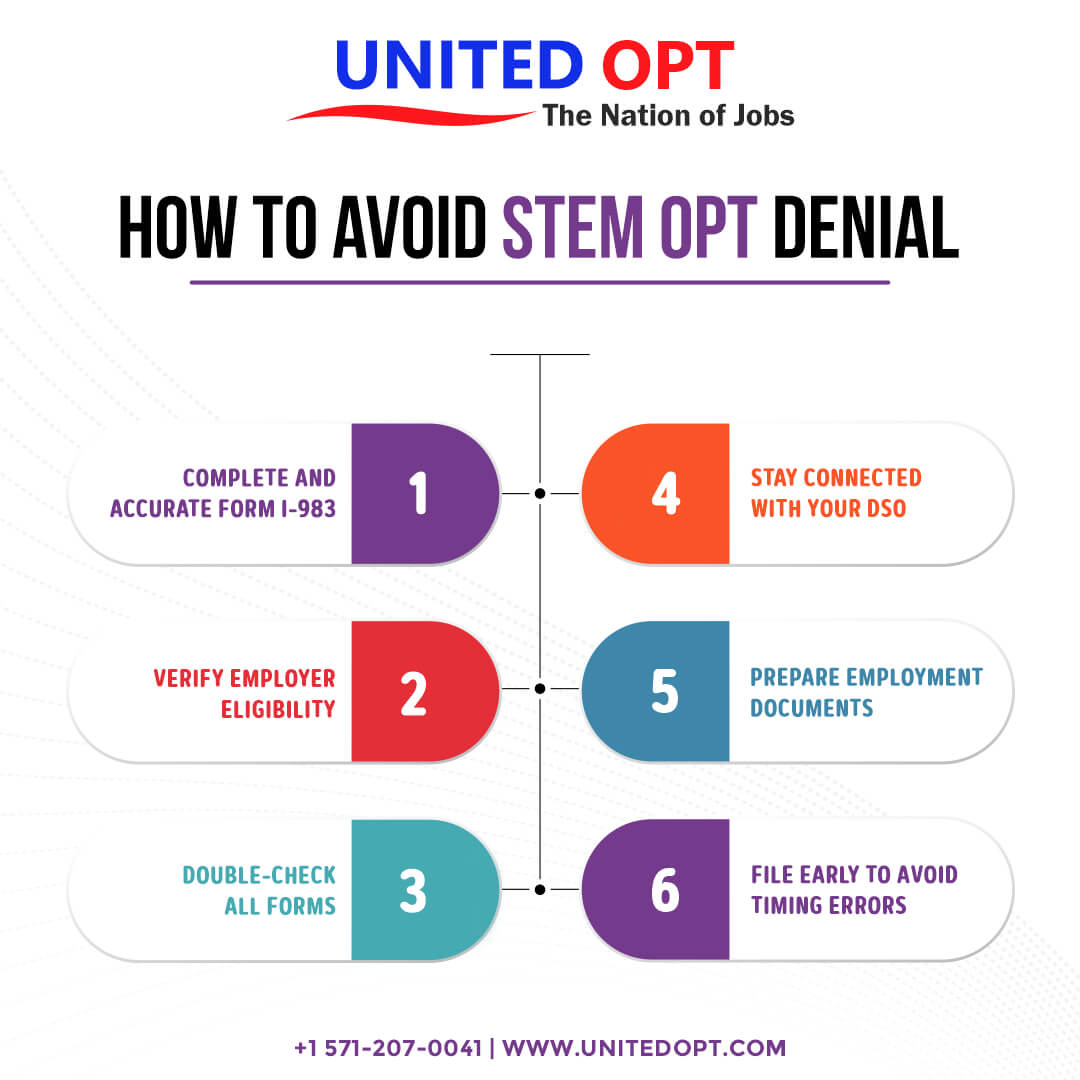
Avoiding OPT Extension denial can be a challenging task; however, it can be easily accomplished by following the steps below.
- Ensure the Form I-983 is completely compliant, detailed, and accurately reflects the employer's training procedure.
- Confirm the employer's eligibility, which includes proper supervision and valid E-Verify registrations.
- Review all your forms, including the I-20, I-765, and I-983, verify signatures, and maintain correct SEVIS information in order to ensure data accuracy.
- Importance of Timely Communication with the DSO to Correct Outdated or Incorrect Documents
- Prepare all the employee's evidence documents, such as the offer letter, job description, and pay details.
- Prevent time-related mistakes by filing your STEM OPT extension early
Your Roadmap After a STEM OPT 2025 Denial
After OPT extension denial following steps should be taken:
- Review the denial notice carefully and understand what requirement was not met.
- Contact your DSO and discuss possible re-filing or appeal options.
- Prepare a corrected application in case the denial is related to technical errors.
- Search and explore alternative visa categories and a change of visa status if refilling is unavailable.
- Get in touch with an immigration advisor for guidance on deadlines and maintaining your F-1 status.
- Consider travel and re-entry strategies if eligible, based on your specific situation.
A crucial reminder, since denials can occur even with a carefully prepared application. Stay calm and approach the situation thoughtfully.
Summary
STEM OPT denials in 2025 are significantly rising, with most of the denials can be avoided by avoiding common mistakes. With careful preparation, accurate forms, and proper documentation, a student can increase their chances for approval. Staying active and understanding how USCIS can elevate your application can help you navigate the process, avoid unnecessary delays, and result in a secure long-term career plan. Visit UnitedOPT for STEM OPT denial information for a better future.
FAQ’s
1. What are the most common stem opt denial reasons?
Below are the common reasons for STEM OPT denial:
- Incomplete Form I-983 and incorrect filing timelines
- The employer does not meet the STEM requirements
- The job does not match the STEM degree
- Missing signatures on the form
2. How to reapply after a USCIS OPT denial in 2025?
If your denial involves some technical mistakes, you can do the following:
- Refile a corrected application
- Ensure your DSO updates you I-20
- Act within scheduled timelines
- Consult an adviser and cross-check before hiring
3. Can OPT extension denial affect my F-1 Visa status?
Yes, it can if your OPT EAD has already expired; this may give you a 60-day grace period. Your employment must stop immediately; the status options are time sensitive, and any delays can lead to your F-1 status being canceled. When this happens, a student should seek guidance immediately to avoid any future problems.
4. How can an international student prevent OPT extension denial?
The following are the methods that should be used to avoid denials:
- Check every form twice before submitting
- File early within the allowed window
- Use a STEM-eligible employer only
- Applying for a job role that matches your degree
- Keep contacting your DSO for updates
5. What documents are important for a STEM OPT application?
Below is a list of important documents for the STEM OPT application:
- Accurate form I-983
- Updated I-20 form with STEM recommendation
- Corrected I-765
- A detailed job description
- Proof of employer supervision
6. What will happen if my employer does not follow E-verification?
When an employer doesn’t follow E-verification, the USCIS denies the application. The employer must be fully registered and should avoid participating with employers that do not use E-Verify. This is because:
- You cannot substitute another employer
- Correct and update the document before filing only
- Confirm compliance early
Clara Michael
Clara Michael is a Career Counsellor and Legal advisor at United OPT. she has very good working experience with OPT, CPT and H1B candidates. She has a vast knowledge of recruitment and immigration laws. Through her experience and knowledge, she is giving her best to support the international student community in the USA. Do share the article if you like it.