H-1B Lottery 2026 Changes: What the New System Means for OPT Students
Blog Index
- 1. Introduction to AI Careers in the USA
- 2. Why AI is a Top Career Choice in 2025
- 3. Job Opportunities for International & F1 OPT Students
- 4. STEM OPT Extension and AI Roles
- 5. Top Companies Hiring AI Talent in the USA
- 6. Skills Needed for AI Jobs
- 7. Salary Trends in AI Careers
- 8. Tips for Success in the AI Job Market
- 9. Conclusion
- 10. FAQs
INTRODUCTION
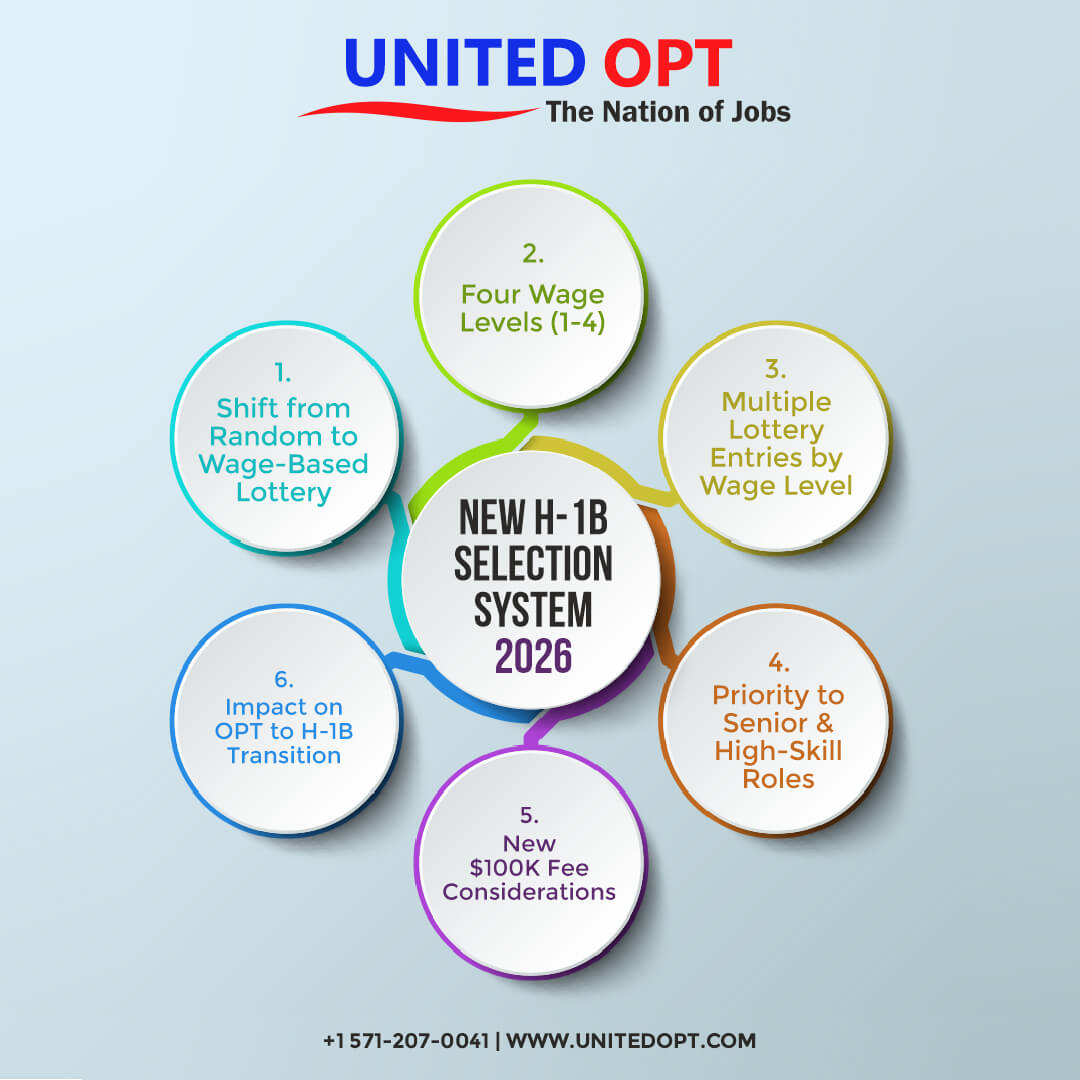
The 2026 H-1B lottery change introduces a new “H-1B wage-based selection 2026.” Over the past year, the H-1B lottery has been conducted by random selection from a pool of registered candidates, but now a wage-weighted H-1B lottery will be conducted. According to this, applicants will be divided into levels based on their wages, and the number of lottery entries will vary by level. The higher the wage, the higher the chances of winning the lottery. This may reduce the likelihood that CPT and OPT will convert to H-1B status, as F-1 students will mostly apply for entry-level jobs. In this blog, we will understand the H-1B new selection system in 2026 and its impact on OPT students.
What is the H-1B new selection system in 2026?
In 2026, USCIS will not conduct a random computer-generated lottery. Instead, USCIS is conducting a wage-weighted H-1B lottery, in which employers with higher wages are more likely to be selected.
The US Department of Labor has the complete data on wages and jobs. Each occupation is officially assigned a classification code called the SOC (Standard Occupational Classification). And four wage levels, from level 1 (entry-level) to level 4 (highly specialized or senior roles).
For the H-1B cap FY2027 system, employers must specify each applicant's SOC job code and work location. Then the employer has to clarify the wage level for the applicant; higher-wage applicants will have a better chance of entering the lottery.
The H-1B wage levels and lottery entries are as follows:
| Wage level | No. of Lottery entry chances | Estimated chances of getting picked |
|---|---|---|
| Level-4 | 4 | 61% |
| Level-3 | 3 | 46% |
| Level-2 | 2 | 31% |
| Level-1 | 1 | 15% |
If selected in the H-1B wage-based selection 2026, the employer must pay the wage and reaffirm the geographic area used in the application submission. Disobedience to the rule can lead to future denials.
Why is a new H-1B wage-based selection 2026 needed?
More prioritization of high-skilled/paid workers: 2026 H-1B lottery change uses a weighted system that gives higher-level workers (levels 3 or 4) priority; earlier, a new candidate or a senior developer had the same chance in the random lottery. The goal is to select workers who can bring more economic value.
Removing fraud & duplicate registrations: In recent years, the U.S. government discovered that some consulting firms submitted duplicate registrations for the same candidate. This increased lottery odds unfairly. The new H-1B visa selection update makes it harder to game the system.
Market-based hiring: The Previous H-1B lottery system was a random selection method; the H-1B wage-based selection 2026 makes it a demand/value-driven method. If an employer pays more, it’s likely to reflect a higher skill or demand. H-1B wage selection aligns with a labor shortage.
Why the new $100,000 fee considerations for some H-1B applicants?
The U.S. government introduced a new $100,000 fee as part of the H-1B visa selection update.
The new $100,000 fee applies to candidates who file an H-1B petition outside the U.S. or who travel while the H-1B process is underway. And if applicable, the employer will have to pay it.
The fee is not applicable to applicants who are in the United States for the complete H-1B process (from filing through full approval). This fee is not part of the H-1B new selection system and is relevant only at the time of petition filing.
Employers should make sure their employees, if selected in the H-1B lottery, are present in the United States for the petition filing.
A prospective H-1B employee should stay in the U.S. until the start of the H-1B status (Oct 1, 2026).
Who should be registered, or who is exempt from the lottery?
The H-1B cap lottery 2026 is for a new H-1B visa, not for H-1B transfer or extension. Hence, the following should register for the H-1B lottery:
- F-1 students on OPT or CPT, F-1 students seeking OPT to H-1B chances.
- Spouses who want their own independent visa: this category includes spouses on H-4 or E-visa status.
- Green card-seeking TN professionals.
Categories that are exempt from the H-1B cap lottery:
- H-1B transferring from one U.S. employer to another.
- H-1B extension.
- U.S college or university workers.
- Non-profit institution or organization workers.
- Non-profit research organizations.
These categories are exempt from the H-1B cap; they can apply for H-1B visas at any time throughout the Fiscal year. But the $100,000 fee may apply in some cases.
What is the H-1B rule impact on OPT students?
Tougher competition for Entry-level jobs: If H-1B moves from random lottery to wage-based selection, entry-level jobs have to face tough competition. The priority is given to high-wage or senior jobs.
Increased scrutiny: USCIS has increased scrutiny of the bachelor's degree requirement and whether the degree matches the job role. Therefore, OPT students must work in jobs related to their major and ensure the description matches the student’s degree.
Employer preference: If the H-1B process becomes more complex and expensive, employers would likely prefer experienced employees over entry-level workers. This may reduce the OPT to H-1B chances.
Increased fees affect employer decisions: Even a small change in registration fees can affect small companies' decisions to sponsor or not.
Wrap up
The new wage-weighted H-1B lottery will give higher-wage employees a better chance, shifting the system from random selection to skill and wage-based selection. Priority and preference will be given to senior roles, making it more difficult for F-1 OPT holders to convert to H-1B status. The U.S. government has also introduced a new $100,000 fee for different H-1B petition scenarios.
FAQ’s
1. What is the concept of the H-1B visa?
- For speciality occupations that the current U.S. workers cannot meet the requirements, the U.S. allows a work visa to hire foreign talent called the H-1B visa.
- This visa is for hiring foreign talent in sectors such as tech and finance etc.
- The H-1B work visa is sponsored by the employer; without an employer, you cannot register for an H-1B visa.
2. How to understand the H-1B lottery?
- Each year, demand for new H-1B visas exceeds supply.
- The U.S. government selects petition applicants through a lottery called the H-1B lottery.
- Out of all the applicants, only 85,000 are selected for a petition filing.
3. What is the 2026 H-1B lottery change?
- For past years, the lottery has been conducted, putting all candidates in the same pool and selecting them at random.
- All candidates get an equal chance of being picked in the lottery.
- In 2026, a wage-weighted H-1B lottery is introduced.
- Candidates with higher wages will have a greater chance of re-entering the H-1B lottery and thus being selected for petition filing.
4. What kind of roles are exempt from the lottery for the H-1B visa?
The categories exempt from the H-1B cap lottery primarily include non-profit and educational roles. Below are the examples:
- H-1B transferring
- H-1B extension
- U.S college or university workers
- Non-profit institution or organization workers.
- Non-profit research organizations.
5. What are the H-1B lottery chances for 2026 according to wage level?
- Level-4: 61% chance (No. of lottery entry chances - 4)
- Level-3: 46% chance (No. of lottery entry chances - 3)
- Level-2: 31% chance (No. of lottery entry chances - 2)
- Level-1: 15% chance (No. of lottery entry chances - 1)
6. How does the H-1B new selection system affect OPT to H-1B chances?
- Tough competition for entry-level jobs as the lottery system changes to wage-based selection.
- As the lottery process becomes more complex and expanded, employers prefer to hire more skilled employees, thereby reducing their chances of obtaining an OPT to an H-1 B.
- A small change in the H-1B fees affects small companies to sponsor H-1B visas.
Clara Michael
Clara Michael is a Career Counsellor and Legal advisor at United OPT. she has very good working experience with OPT, CPT and H1B candidates. She has a vast knowledge of recruitment and immigration laws. Through her experience and knowledge, she is giving her best to support the international student community in the USA. Do share the article if you like it.