The $100K H-1B Fee: What It Means for Employers, Tech, and Global Talent
Blog Index
- 1. Introduction to AI Careers in the USA
- 2. Why AI is a Top Career Choice in 2025
- 3. Job Opportunities for International & F1 OPT Students
- 4. STEM OPT Extension and AI Roles
- 5. Top Companies Hiring AI Talent in the USA
- 6. Skills Needed for AI Jobs
- 7. Salary Trends in AI Careers
- 8. Tips for Success in the AI Job Market
- 9. Conclusion
- 10. FAQs
INTRODUCTION
On September 19, 2025, a new presidential proclamation shook the U.S. tech and immigration landscape by imposing an unprecedented $100,000 fee on H-1B visa petitions. The order, which took effect on September 21, 2025, is framed as a measure to protect U.S. jobs and wages, curb outsourcing that relies on lower-paid foreign workers, and redirect H-1B usage toward higher-paying, higher-skilled roles. Employers, startups, and international graduates alike have been left stunned. This blog explores the proclamation, its implications, and its potential impact on H-1B holders and employers.
What the Proclamation Actually Says
-
Key Details & Effective Date
- The proclamation is titled “Restriction on Entry of Certain Nonimmigrant Workers.”
- It requires employers to pay $100,000 (USD) for H-1B visa petitions at the time of filing.
- The restriction took effect on September 21, 2025.
-
Who Is Affected?
- The $100,000 H-1B petition fee applies to new H-1B beneficiaries who have not yet entered the U.S. and whose petitions were filed on or after the effective date.
- Employers must present proof of payment of the $100,000 fee. Petitions without proof will be denied.
- The Departments of Homeland Security and State will verify payment before issuing the visa.
-
Who Is Not Affected?
The White House later clarified that the following groups are not affected by the new fee requirement:
- Current H-1B visa holders with a valid visa.
- Those with H-1B petitions filed before the effective date.
- Beneficiaries with already approved petitions.
- Individuals already in the U.S. with valid H-1B status filing for extensions, amendments, or change of status.
- Discretion Clause: The fee may be waived if the Secretary of Homeland Security deems the case in the national interest (e.g., humanitarian reasons, healthcare, or defense needs).
Direct Impact on Employers and International Talent
The $100K fee will heavily affect employers’ hiring plans and international workers’ career opportunities:
- Employers filing new H-1B petitions for employees abroad must now budget an additional $100,000 per petition.
- Proof of payment must accompany the petition submission.
- International talent will depend heavily on whether employers are willing to absorb the cost.
- While existing H-1B visa holders are exempt, travel complications may arise if interpretations at ports of entry vary.
- Companies may delay or freeze foreign hiring, especially startups and mid-sized firms.
- Industries heavily reliant on international STEM talent could face disruption.
Why the Order Faces Legal Challenges
-
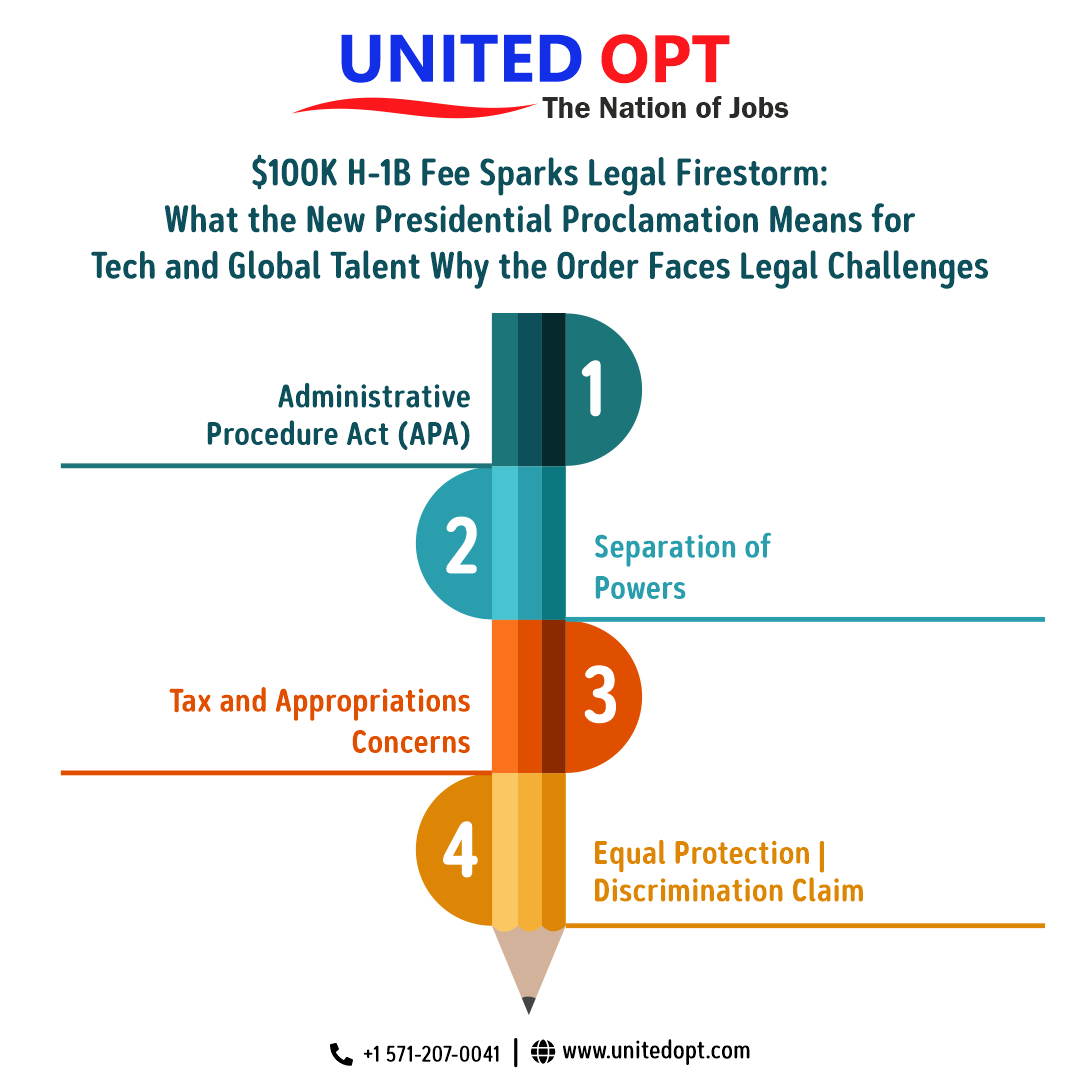
1. Administrative Procedure Act (APA)
The fee violates the APA because it was imposed without the required “notice and comment” rulemaking process.
-
2. Separation of Powers
U.S. law grants Congress—not the President—the authority to set immigration fees. Courts may see this as executive overreach.
-
3. Tax and Appropriations Concerns
Critics argue that bypassing Congress in setting such a fee makes it unconstitutional.
-
4. Equal Protection / Discrimination Claims
The fee disproportionately impacts international workers in technology-heavy industries, raising concerns of discrimination under equal protection principles.
Practical Impact on H-1B Holders and Employers
Travel Considerations for Existing H-1B Workers
- Current H-1B holders in the U.S. are not subject to the $100K fee.
- However, renewals at U.S. consulates may face delays or inconsistent interpretations.
- Even though re-entry on a valid H-1B is exempt, international travelers should carry documentation of their valid visa and approved petition.
Hiring Delays and Freezes for Employers
- Many firms are halting or reconsidering global hiring strategies.
- Startups and smaller companies face the greatest challenges, as the added cost can derail recruitment plans.
- Large tech firms may absorb the cost but are likely to delay international hiring until legal clarity is reached.
- Seasonal and specialized industries reliant on foreign workers could experience skill shortages.
Steps Employers Should Take
- Consult Immigration Counsel Early – Review upcoming petitions to determine applicability of the fee.
- Document Harms for Possible Litigation – Keep records of lost contracts, delayed projects, or staffing shortages.
- Assess Waiver Eligibility – Prepare evidence-based waiver requests for roles in national interest sectors (e.g., healthcare, defense).
- Budget Contingencies – Factor the $100K fee into future hiring and financial planning.
CONCLUSION
This proclamation represents one of the most dramatic shifts in the employment-based immigration system. While it is positioned as a safeguard for U.S. jobs and wages, it imposes heavy legal and financial burdens on employers and international talent alike. Existing H-1B workers are largely shielded, but new global hires now face steep costs, heightened travel risks, and potential hiring freezes. The outcome will depend heavily on pending court challenges. For more insights on H-1B visa news and job search opportunities, visit UNITED OPT.
FAQ’s
1. What is the $100K H-1B fee?
It is a mandatory employer-paid fee of $100,000 for each new H-1B petition, established under the presidential proclamation of September 19, 2025.
2. Who will be affected by this fee?
Primarily tech companies and industries dependent on international talent. Current H-1B holders are exempt but may face confusion at consulates or ports of entry.
3. Why is this fee being challenged in court?
Legal challenges focus on:
- Violations of the Administrative Procedure Act
- Separation of powers concerns
- Constitutional taxation limits
- Equal protection and discrimination claims
4. What should employers and H-1B workers do now?
- Employers should consult immigration attorneys before filing or paying.
- Workers should avoid unnecessary travel and stay informed about legal updates.
5. How will this affect tech companies?
- Startups and mid-sized firms may delay or cancel foreign hiring.
- Large tech firms may absorb the cost but slow down recruitment until the courts decide.
- Industries reliant on specialty or seasonal talent may face shortages.
6. Is this fee permanent?
Not necessarily. It is already facing court challenges, and aspects of it may be blocked or overturned.
7. Are all H-1B visas affected?
No. The proclamation primarily applies to new H-1B petitions filed after September 21, 2025, for beneficiaries outside the U.S. Existing visas and petitions filed earlier are not impacted.
Clara Michael
Clara Michael is a Career Counsellor and Legal advisor at United OPT. she has very good working experience with OPT, CPT and H1B candidates. She has a vast knowledge of recruitment and immigration laws. Through her experience and knowledge, she is giving her best to support the international student community in the USA. Do share the article if you like it.